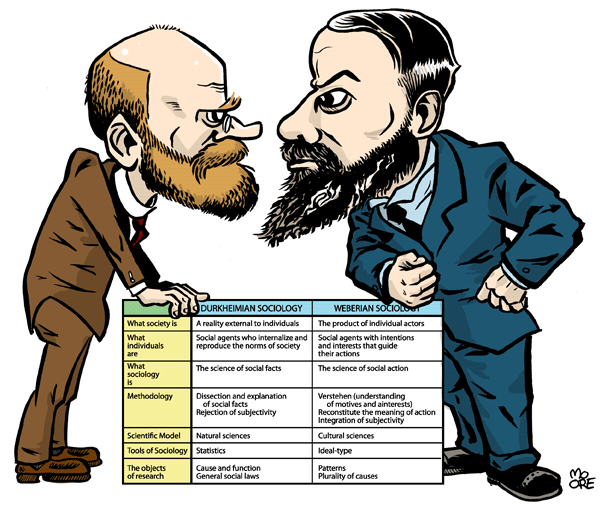
Sociological Theories Applied to the Conflict
Emile Durkheim saw religion as rooted in society; deeply connecting humans through social constructs, rituals, totems, and symbols which drove common identity and belonging. Daniel L. Pals in his Eight Theories of Religion offers a brief explanation for this, “Human beings, after all, are never just individuals, they always belong to something” (Pals, 2006, p.85). The sacred nature of the fabric of society to Durkheim is that the group itself identifies and surrounds a common goal, which is often the health and success of the social group. Within the Palestine/ Israel conflict, Jerusalum (specifically the site of Temple Mount/ Al-Aqsa Mosque) can be seen as a sacred symbol for both the Israelis and the Palestinians. For Jewish Israelis, it is a totemic symbol of survival and resilience and known to them as the eternal city, home to the Western Wall, a remnant of the Second Temple. For Muslim Palestinians, it is home to the Al-Aqsa mosque. It remains one of the holiest sites for Muslims as well as serving as a symbol of political and social resistance in the face of threats to its accessibility or future(A Year of War: Israelis and Palestinians: FRONTLINE). This site is often the scene for many political and religious clashes, protests, and violence. In April of 2023, as Holy Week, Passover, and Ramadan all converged, miscommunication and violence surrounding religious practices and rituals at the holy site led to a military escalation which included the launching of a barrage of missiles from Lebanon and Gaza into Israel, resulting in return fire back with similar strikes in Tel Aviv and the West Bank (William Marx, 2023, NPR). Using Pals’ analysis of Durkheim's framework here, we see how symbolism and totems in religious societies help represent the group's moral portrayal and ideological compass. As Pals points out, when groups battle over the sacred, they are “preserving and protecting the very ‘soul of society’”(Pals, 2006, p.106). The language here then leads the secular observer to recognize a region where societal struggles for ethno-religious superiority and collective belonging take center stage within this conflict.
Max Weber highlights how religion can be used to shape individual motivation and then in turn behavior within socially constructed environments. When discussing the dispute over land in the region of what is today known as Israel, Pals’ analysis of Weber’s theories of religion as a source of social action can almost explicitly be identified in the Zionist movement. There is a deep belief in Judaism that the return to the land of Israel is a prophetic destiny in which religious fulfillment is achieved through political and social action, or as Weber describes “actions can be either instrumentally rational (seeking the means to achieve a goal) or value-rational (seeking a goal as good in itself) (Pals, 2006, p 154). In Weber’s framing, the goal of Israel will always be the protection, preservation, and promotion of the state and the group it represents. Similarly, among many Palestinian groups, Islamic teachings provide a moral justification and ‘value-rational’ for resistance. The concept of Jihad for many Muslims is interpreted literally and used as a moral framework for justifying an armed struggle as religiously moral(Esposito, Jihad: Holy or Unholy War?). Pals also highlights through Weber how religion helps a group heal and come to terms with persecution and suffering. Among Jewish Israelis, the Holocaust, pogroms, and centuries of religious violence have helped shape a sense of social collective belonging which drives identity both individually and as a group. This goes hand and hand with how Weber sees the role religion plays in legitimizing leaders both politically and religiously within traditional or historical narratives such as prophetic claims to land.
Theories Applied
Although Weber and Durkheim focus on different aspects that the role of religion plays in society, we see prime examples of how their theories are at play in such an ethno-religiously diverse region such as the Middle East. Recently there has been a re-escalation of the destruction of Gaza with growing calls for a complete forced removal of the Palestinian people in the region. Benjamin Netanyahu signaled in February of 2025 that he is moving forward with the American President’s plan of a forced removal of the Palestinian people from Gaza (Lee and Melzer, AP). This authority on the part of these leaders is what Weber claims connects directly to religious authority and morality, and how religious tradition, doctrine, and practice can be manipulated to justify political or military “social action”. Similarly, if the messaging coming from the state (which is ultimately mutually aligned with said religion in a non-secular society) is that of resistance and/or defense, then Durkheim's theories of a nation as sacred and social cohesion can be applied. Durkheim explored how this moral authority is sanctioned through society as the group embodies shared interests and then returns that authority to the state in support. There are real-time examples of this as the conflict continues; military recruitment is up and defense from each side only grows stronger (Yohanan, The Times of Israel). In a non-secular society where religious authority flows to and from leadership to the masses and back in a cyclical fashion, it is clear that the functions of religion operate in ideological, political, and functional ways to be used for the benefit of the state.